What Happens If You Do Not Invest in SEO for Your Business?

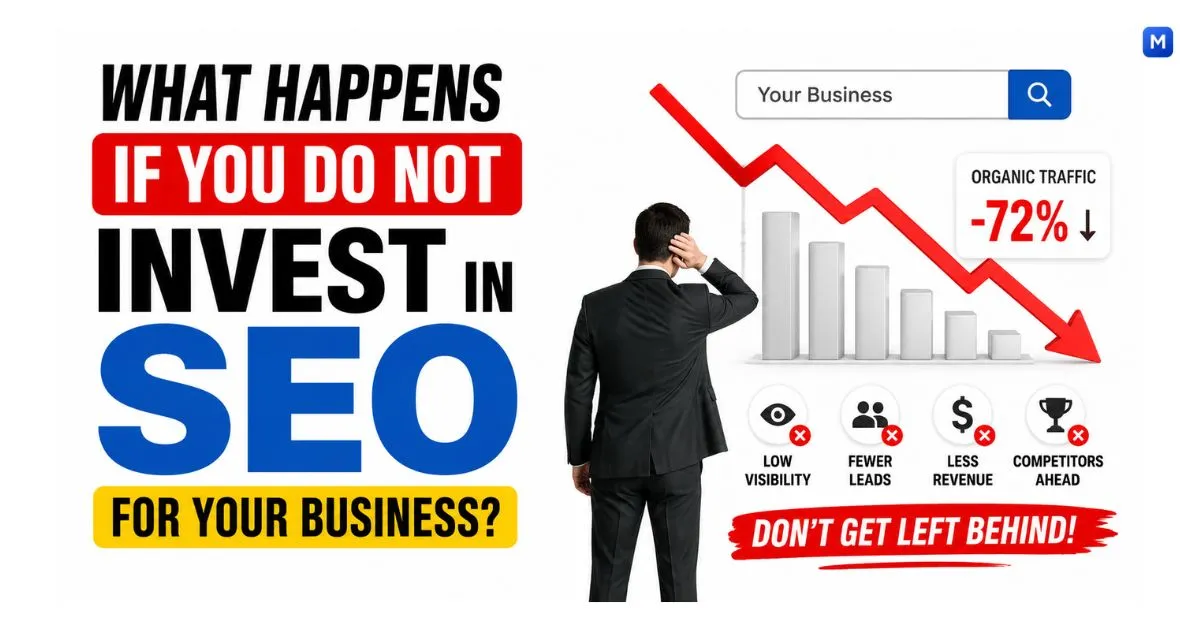
What happens if you do not invest in SEO for your business? Your competitor just got another inquiry from Google while your website remained invisible. Not because their service is better. Not because their product is cheaper. Simply because they showed up in search results and you did not.
This is what happens every single day when a business delays SEO. The loss is quiet. It does not show up in any report. But it compounds — week after week, month after month. In this article, I will walk you through exactly what that costs your business, why it happens, and what you can do before the gap becomes impossible to close.
What Happens If You Do Not Invest in SEO? (Quick Answer)
If a business does not invest in SEO, it loses organic visibility, website traffic, qualified leads, and revenue over time. Competitors capture search demand while customer acquisition costs increase. The longer it continues, the harder and more expensive it becomes to recover.
Here is what that looks like in practice:
- No search visibility — Customers searching for your service never find you.
- Zero organic traffic — Every visitor has to come from paid ads or referrals.
- Lost leads daily — People who needed exactly what you offer went to a competitor.
- Weaker brand trust — Businesses that rank consistently look more credible.
- Growing ad dependency — You keep spending more just to stay visible.
Key Takeaways
- SEO builds organic visibility that compounds over time.
- Without SEO, competitors capture the customers you are missing.
- Paid ads stop working the moment your budget stops.
- SEO reduces customer acquisition costs over the long term.
- Starting early is always cheaper than trying to catch up later.
Why SEO Is Important for Business Growth
Search is not just a marketing channel. It is where your customers make decisions.
According to BrightEdge research, over 68 percent of all online experiences begin with a search engine. Your customers search before they call. They search before they visit. They search before they buy.
SEO helps your business appear exactly when their search intent matches what you offer. That timing is something no paid campaign can replicate at the same cost.
How the Customer Buying Journey Works in Search
Every customer goes through three stages before making a decision.
At the awareness stage, they search broadly — “how to get more customers online” or “why is my website not getting traffic.” They do not know your business yet. If your content appears here, your brand enters their mind first.
At the consideration stage, they compare options — “SEO vs paid ads” or “best SEO agency for small business.” This is where helpful content builds trust and positions you as the right choice.
At the decision stage, they are ready — “hire an SEO expert in Delhi” or “SEO services for real estate.” If you are not ranking here, you are losing customers who are actively ready to spend.
SEO keeps you visible across all three stages. No single paid campaign covers all three. If you want to understand this in more depth, read why small businesses need SEO and how it directly impacts growth at every stage.
Your Competitors Are Capturing the Customers You Are Losing
When your website does not rank, it is not a neutral situation. Someone else is ranking instead — and collecting every click, every inquiry, every sale that could have been yours.
How Rankings Control Clicks
According to FirstPageSage and Backlinko research, the first organic result on Google gets 27 to 30 percent of all clicks. By position five, that drops to around five percent. Position ten gets less than two percent.
Fewer than one percent of users ever click to page two.
So while you are on page two or three, your competitor in position one is getting fifteen times more traffic than you. Every single day.
What Happens When Competitors Consistently Outrank You
It goes deeper than traffic.
When the same competitor repeatedly appears above you, customers start associating that brand with authority. They read their content. They visit their website. By the time they reach out to anyone, that competitor already feels like the obvious choice.
Market share in search shifts slowly — but once a competitor builds strong domain authority and a large content library, displacing them becomes very expensive and very slow.
Every month you wait, that gap widens. Closing it later costs significantly more than starting now would have.
The Hidden Cost of Ignoring SEO: Lost Traffic, Leads, and Revenue
Most business owners think of SEO as a marketing expense. Think of it instead as revenue infrastructure.
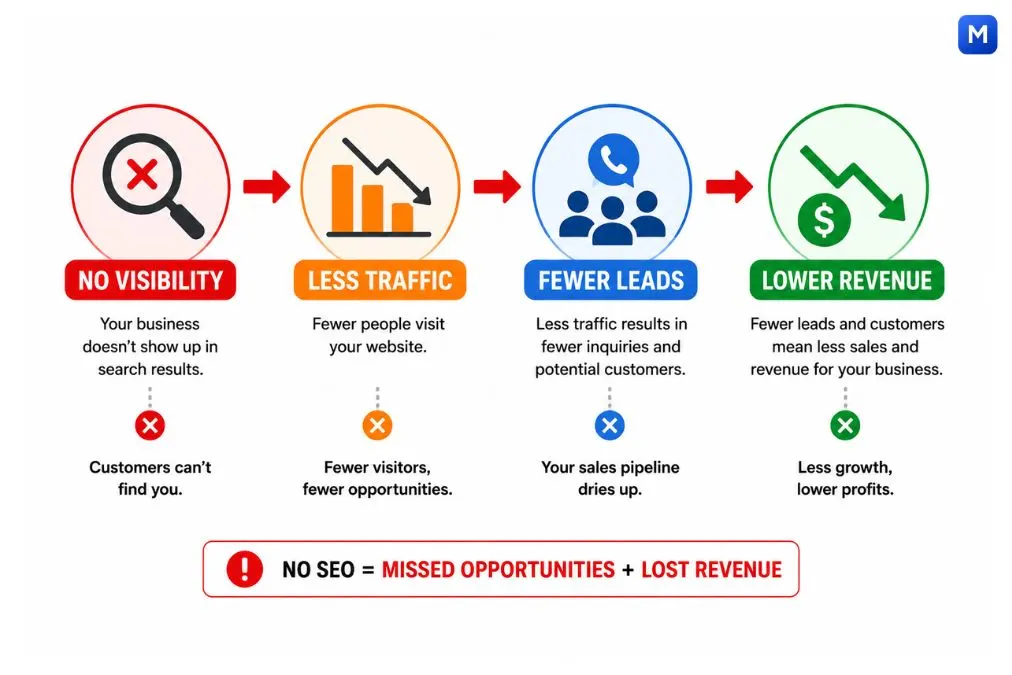
Here is the chain that breaks when SEO is missing:
No Visibility → No Traffic → No Leads → No Revenue
Each link in that chain has a real financial value.
Say your target keyword gets 1,000 searches per month. Position one gets roughly 280 visitors monthly — free, with no per-click cost. Your competitor ranks there. You get zero.
Multiply that across twenty or thirty keywords your customers are searching for. The cumulative loss is enormous.
SEO also directly reduces customer acquisition costs by generating qualified organic traffic that continues to arrive without additional spend. One real estate client I worked with in the Delhi-NCR market reduced their cost per lead by 38 percent within fourteen months — simply by building consistent organic traffic through targeted content and local SEO. Their leads continued even during months when the ad budget was paused.
That is the difference between a marketing expense and a compounding asset.
| Factor | Without SEO | With SEO |
| Traffic source | Stops when ads stop | Compounds organically over time |
| Customer acquisition cost | Increases quarter over quarter | Decreases as organic traffic grows |
| Search visibility | Zero without paid budget | Builds and holds independently |
| Search demand | Competitors capture it all | You capture your share |
| Long-term asset | None — ad spend disappears | Domain authority grows continuously |
| Lead quality | Mixed — paid intent varies | Higher — organic intent is stronger |
The hidden cost of ignoring SEO is not just the money you spend on ads. It is the organic revenue you are never building.
Customers May Trust Your Competitors More Than You
Here is something most business owners do not think about.
When a customer searches for a service and sees a business in the top three results, they make an unconscious assumption — that the business is established, credible, and trustworthy. In the customer’s mind, Google has already done the vetting.
Your competitors who rank well are not just getting more traffic. They are getting more trust before a single conversation happens.
Consider two scenarios. A customer searches for your service. They find your competitor at position one — a clean website, helpful content, and strong reviews. Then they find your business buried on page two, or through a paid ad.
Which business feels like the market leader?
Almost always, the one that showed up organically first.
Website authority — built through quality content, backlinks, and technical strength — is not just a Google ranking signal. It is a human trust signal. Customers who find you organically during their research phase already see you as the expert before they ever contact you.
Local Businesses Lose Nearby Customers Without SEO
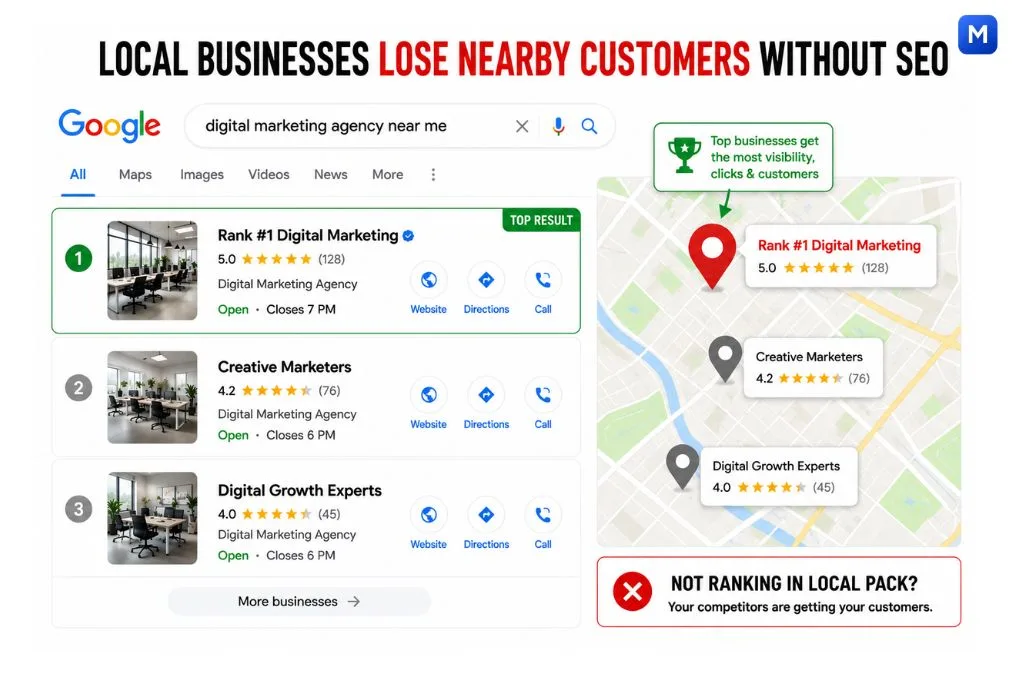
If you run a local business — a clinic, real estate firm, consultancy, or retail store — this matters even more.
When I work with Delhi-NCR clients in Faridabad and Greater Noida, the first thing I check is their local search visibility. Most are losing customers to competitors just two kilometers away — simply because their local SEO foundation is missing.
Most people searching for local services use near me queries or add a city name. “Real estate agent in Faridabad.” “Digital marketing company Greater Noida.” “SEO expert near me.”
Google responds with the Local Pack — those three business listings with maps, ratings, and contact details at the very top of the page. If you are not there, you are invisible to customers who are ready to buy right now.
Here is what getting into the Local Pack actually requires:
- Google Business Profile is fully verified and updated with accurate NAP — name, address, phone number
- Business category, description, services, and photos are properly filled in
- Consistent NAP information across all online directories
- Regular Google Business Profile posts to signal an active presence
- Genuine customer reviews with responses from your side
- Locally relevant content on your website targeting city-specific keywords
Most small businesses in India still have incomplete Google Business Profiles. That is an opportunity. A properly optimized local presence regularly outranks much larger competitors in Maps visibility and local search rankings.
Every local competitor investing in local SEO is capturing customers in your area. Without it, those customers never reach you — even when they are searching for exactly what you offer.
SEO vs Paid Advertising: Can Ads Replace SEO?
This is the most common hesitation I hear. “We are already running Google Ads. Why do we need SEO?”
Fair question. Here is the honest answer.
What Paid Advertising Does Well
Paid ads deliver immediate visibility. New product launch, seasonal campaign, specific geographic push — ads work fast. You control who sees them, when, and what message they receive.
For real estate clients, Meta Ads are critical for new project launches that need immediate inquiries. Paid advertising has a genuine role in a smart digital strategy.
The Biggest Limitation of Relying Only on Ads
The moment your budget stops, your visibility stops. Completely.
No residual benefit. No compounding return. Every rupee spent built someone else’s platform — not your own.
Ad costs also rise over time as more competitors enter the auction. Cost per click goes up. Cost per lead increases. The efficiency of paid channels erodes naturally as markets mature.
I have seen businesses that built their entire customer acquisition on paid ads face serious problems when ad costs doubled. They had no organic foundation to fall back on.
Why SEO Builds Long-Term Marketing Value
SEO works differently. Content published today, authority built over months, rankings earned through consistent work — none of this disappears when you pause for a month. It compounds.
One of the biggest SEO investment benefits is that rankings continue generating visibility long after the initial work is completed. A well-ranked page delivers qualified leads for years with minimal ongoing cost. A paused ad delivers nothing.
The right strategy uses both — but always builds the organic foundation through SEO first. For a detailed breakdown of how these two channels compare, read SEO vs Google Ads to understand which one fits your business goal at each stage.
5 Warning Signs Your Business Is Already Suffering
The consequences of ignoring SEO are rarely dramatic. They are slow and quiet. By the time they are obvious, significant ground is already lost.
1. Declining Organic Traffic
Log into Google Search Console or Google Analytics. Look at your organic traffic trend over the last six to twelve months. A flat or declining line means rankings are slipping — usually because competitors are improving while you are not.
2. Falling Search Rankings
Check your most important keywords. If you were in position five last year and are now in position twelve, that shift represents a dramatic difference in clicks. A few positions lost on competitive keywords means hundreds of missed visitors monthly.
3. Rising Customer Acquisition Costs
If your cost per lead keeps increasing quarter over quarter, it is often because you have no organic fallback. Businesses with strong SEO absorb paid cost increases because organic leads keep arriving. Without SEO, you have nowhere to turn when paid costs rise.
4. Fewer Qualified Leads
Paid traffic and organic traffic behave differently. People who find you organically through research queries are further along in their decision — more informed, less price-sensitive, easier to close. If your lead quality is declining, the traffic source matters.
5. Competitors Dominating Search Results
Search your own services in Google honestly. If the same two or three competitors appear repeatedly across multiple relevant searches, they are building a structural advantage that becomes harder to overcome every single month.
How to Start Investing in SEO Before the Gap Gets Bigger
Recognizing the problem is step one. Here is how to act on it. You can also explore SEO services for business in 2026 to understand what a complete SEO engagement looks like today.
Build Your Strategy Around Search Intent
The biggest mistake businesses make is creating content around what they want to say instead of what customers are searching for. Before writing anything, understand the intent behind each query — informational, investigational, or transactional. Each requires a different content approach.
Tools like Google Search Console, Ahrefs, and Semrush help identify exactly which queries your customers use at each stage of the buying journey. And if you are evaluating who should lead this work, here is how to choose an SEO expert in Delhi-NCR, so you ask the right questions before hiring.
Create Content That Actually Helps
Google’s Helpful Content Updates from 2023 through 2025 made one thing clear — content must genuinely help a real person make a better decision. No filler. No keyword stuffing. No generic information is available everywhere.
Content that demonstrates real experience and provides practical insight ranks better and converts better. Both goals move together.
Fix Technical SEO First
Content cannot perform if the technical foundation is broken. Page speed, mobile responsiveness, Core Web Vitals, URL structure, schema markup, internal linking, crawlability — these are what allow your content to rank as well as it deserves.
Check your Core Web Vitals in Google Search Console. Fix what is failing before publishing more content.
Measure and Adjust Continuously
SEO is not a one-time project. Track rankings, organic traffic, and lead quality regularly in Google Search Console and Google Analytics 4. When something works, scale it. When something does not, diagnose it.
This is what separates businesses that see compounding results from those who wonder why nothing is improving.
Conclusion
So, what happens if you do not invest in SEO for your business?
You lose visibility. Competitors take your customers. Trust shifts away from your brand. Ad costs keep rising with no organic foundation to fall back on. And the gap grows quietly until it becomes very expensive to close.
Businesses that start SEO early — even with small, consistent steps — build an advantage that compounds over the years. The best time to start was twelve months ago. The second-best time is now.
Begin with Google Search Console. Check your current visibility. See how large the gap already is. And if you are ready to close that gap with a proper strategy, explore professional SEO services built around your business goals.
Every month without SEO is another month of visibility, traffic, and customers handed to competitors.
Frequently Asked Questions
Yes — often more so than for large businesses. Local SEO lets small businesses outrank national brands for specific geographic searches. The key is targeting the right keywords and building authority consistently. Before investing, read the questions to ask before hiring an SEO expert so you know exactly what to evaluate.
Most businesses see meaningful improvements within three to six months. Competitive industries may take six to twelve months. SEO is a long-term investment — businesses that quit at month two never reach the compounding phase.
No. Paid ads stop the moment your budget stops. SEO builds an asset that keeps delivering. A strong strategy uses both — but needs SEO as the long-term foundation.
Rankings hold for a while, then slowly decline over three to six months. Rebuilding lost authority always takes longer than maintaining it would have.
Survive, yes. Grow sustainably, much harder. Every customer who searches for your service and finds a competitor instead is a loss that compounds over time.
A business missing position one for a keyword with 1,000 monthly searches loses roughly 280 potential visitors per month, for that single keyword alone. For businesses in real estate, legal services, healthcare, or B2B consulting, lost traffic can translate into lakhs of rupees in missed revenue each year.
A compounding competitive gap that becomes increasingly expensive to reverse. Every month a competitor builds more content, authority, and trust with Google while you do not.