Why Changing SEO Agency Every 3 Months Is Hurting Your Business

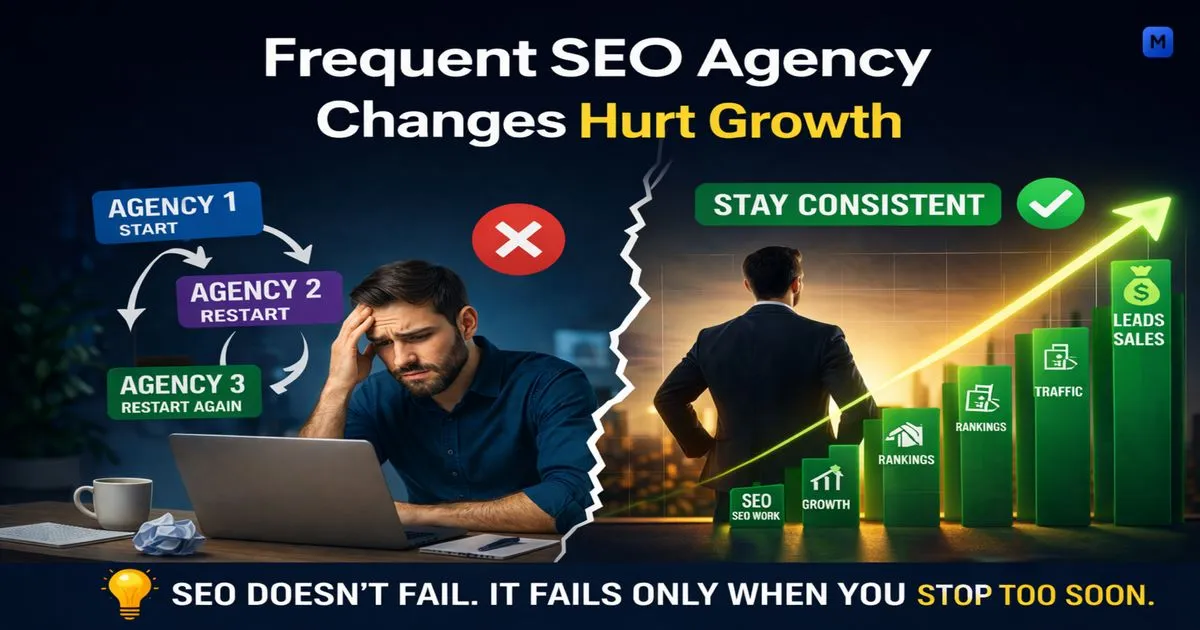
I recently audited a website that had worked with 4 SEO agencies in 14 months. Their traffic? Still flat. Their budget spent? Over ₹8 lakhs. The problem was never SEO. It was the cycle of restarting. Changing SEO agency frequently, especially every 3 months, hurts your business growth and delays real results. Many businesses switch agencies, expecting fast outcomes, but this resets SEO progress and prevents long-term success. Instead of solving the problem, frequent changes make it worse and waste both time and budget.
SEO does not work in short cycles. The first 90 days focus on building a strong foundation, not delivering final results. Search engines need consistent signals, data, and time to understand your website before rankings stabilize and traffic grows.
However, most businesses make a critical mistake. They change their SEO strategy before it reaches its full potential. As a result, they stop the growth process before it even begins. A structured SEO process helps avoid this cycle and builds long-term growth.
Why Do Businesses Keep Changing SEO Agencies Frequently?
Most businesses change SEO agencies because they expect faster results than SEO can realistically deliver. Instead of waiting for the strategy to mature, they judge performance too early. As a result, they switch agencies based on frustration rather than data, which resets progress and delays long-term growth.
After auditing 50+ websites, one thing is clear: this decision rarely comes from actual SEO failure. It usually comes from misunderstanding how this process works. Business owners often ignore early progress signals and focus only on leads or rankings.
Here are the real reasons behind this pattern:
1. No Immediate Results
Most business owners expect visible growth within the first few months. However, SEO focuses on fixing issues and building a foundation in the beginning.
In the first 90 days, work includes:
- Website audits
- Technical fixes
- Content planning
These efforts do not bring instant traffic, but they are critical for future growth. Before traffic increases, impressions start growing in Google Search Console, and keywords begin to index.
If you only focus on leads, you may miss these early progress signals.
2. Unrealistic Expectations from SEO
Another major reason is false expectations created during the sales process. Many agencies promise quick rankings or fixed timelines, which creates the wrong belief from the start.
In reality, no one can guarantee rankings because SEO depends on multiple changing factors. When expectations do not match reality, trust breaks.
At this stage, many businesses make a critical mistake. They change their strategy before it reaches its peak performance.
3. Pressure for Quick Leads and ROI
Every business wants leads quickly, which is completely understandable. However, SEO is not built for instant results like paid advertising.
SEO works by building visibility, authority, and trust over time. Leads come as a result of this process, not immediately.
When you change your SEO agency after three months, you stop the process before your investment delivers results.
The Real SEO Timeline: Month-by-Month Breakdown
SEO works in phases, not instant results. In the first few months, the focus stays on building a strong foundation, fixing issues, and helping search engines understand your website. Real growth starts only after this phase, when trust builds, and results begin to compound over time.
Based on years of hands-on work, SEO follows a clear progression. Each phase plays a specific role in building long-term growth.
Month 1: Audit and Research
- Understand your website structure and performance
- Identify technical issues and content gaps
- Analyze competitors and keyword opportunities
This phase builds the foundation. It does not deliver immediate rankings.
Month 2–3: Implementation Phase
- Fix technical SEO issues
- Optimize pages and content
- Improve internal linking
At this stage, Google starts processing your changes. However, this is still a learning phase.
During this time:
- Rankings may fluctuate
- Google tests your website
- Authority signals start forming
Month 4–6: Early Growth Signals
- Rankings begin to improve
- Impressions increase
- Traffic starts growing
Google evaluates your content quality and value. This is where information gain matters because generic content does not sustain rankings.
Month 6+: Authority and Consistent Growth
- Rankings become more stable
- Traffic grows consistently
- Leads start improving
This is the compounding phase. Every effort starts delivering stronger returns, but only if the strategy stays consistent.
| Month | Focus Area | Expected Output | Common Mistake |
|---|---|---|---|
| 1 | Audit & Research | Baseline data | Expecting rankings |
| 2–3 | Implementation | Google processes changes | Judging by traffic |
| 4–6 | Early growth | Impressions and ranking movement | Switching agency |
| 6–12 | Compounding | Stable traffic and leads | Stopping too early |
SEO delivers results only when you allow the process to complete. If you interrupt it early, you stop growth before it even begins.
Why Are Month 3 SEO Results Misleading?
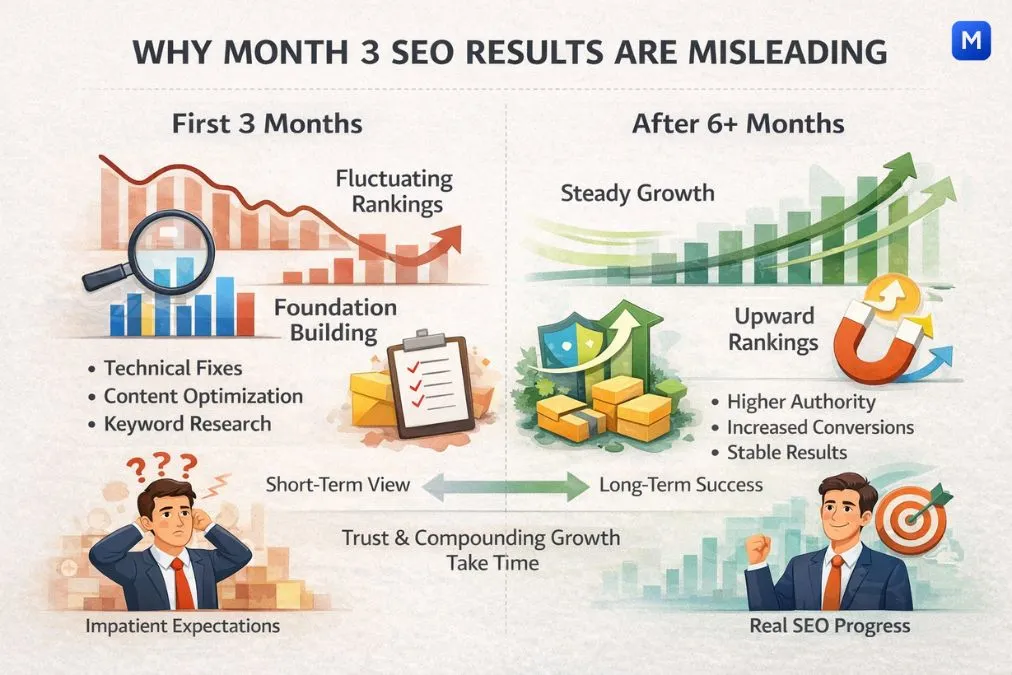
SEO results in 3 months are often misleading because this phase focuses on building a foundation, not delivering final outcomes. Rankings may fluctuate, and traffic may stay low during this period. Real growth starts only after search engines build trust, and your strategy begins to compound over time.
From my experience, most businesses panic at this stage because they focus only on rankings and leads instead of understanding what is actually happening in the background.
What Really Happens in the First 90 Days
In the first 90 days, SEO focuses on fixing issues and setting direction. This includes technical improvements, content alignment, and keyword targeting.
However, these efforts do not bring instant results. Instead, they prepare your website for long-term growth.
What Most Businesses See
Most businesses notice:
- Low or unstable rankings
- Limited traffic growth
- Few or no leads
As a result, they assume SEO is not working. But this view is incomplete and often misleading.
What Is Actually Happening
Search engines start evaluating your website during this phase. They test your pages, process your changes, and gradually build trust.
During this time:
- Impressions begin to increase
- Indexing improves across pages
- Early authority signals start forming
Although results are not fully visible yet, progress is already happening.
Where Businesses Go Wrong
Many businesses make decisions too early. They focus only on rankings and leads instead of understanding the process.
Because of this, they:
- Ignore early progress signals
- Change strategy before it matures
- Reset growth before it begins
What Happens After This Phase
Once this phase completes, things start to change. Rankings become more stable, traffic begins to grow, and leads improve gradually. This is where SEO starts delivering real business results, but only if you stay consistent.
What Happens When You Change SEO Agencies Frequently?
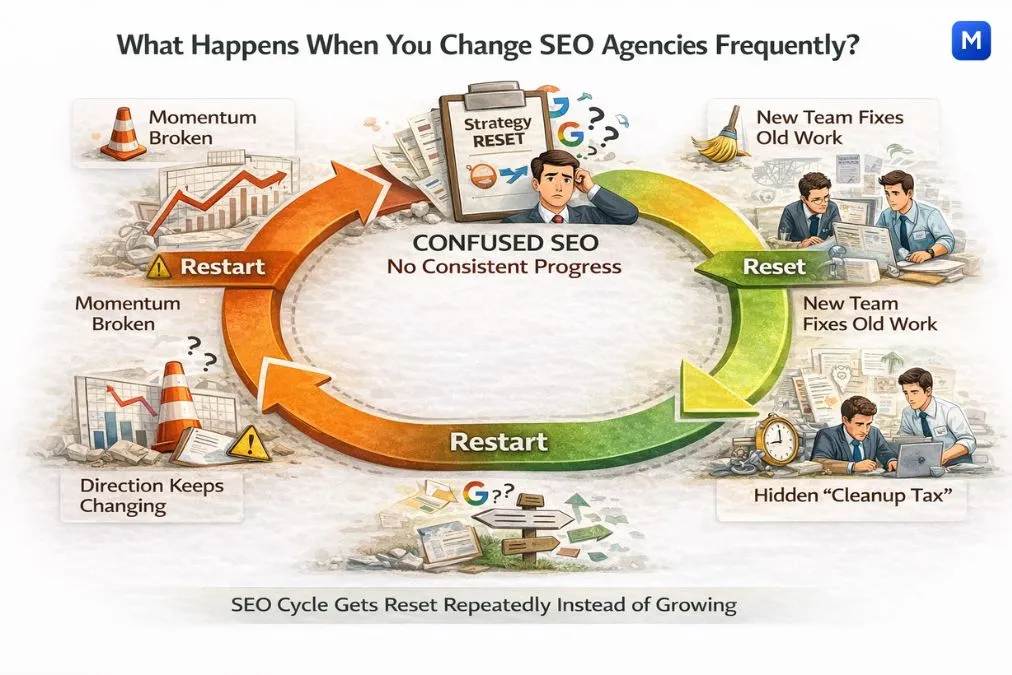
When you change SEO agencies frequently, you reset your entire growth process and delay real results. Each switch breaks momentum, creates confusion for search engines, and forces new teams to restart instead of scaling. As a result, your SEO never reaches the stage where it delivers consistent traffic and leads.
From my experience, frequent switching does not fix SEO problems. It creates a cycle where progress keeps restarting instead of compounding.
Here is what actually happens:
- Your strategy gets reset every time, so there is no long-term direction
- Previous work gets ignored or replaced, even if it was correct
- SEO momentum breaks before it can deliver results
- Google cannot build trust because your signals keep changing
- Your content direction keeps shifting, which confuses your expertise
- You experience “strategy whiplash,” where focus keeps changing
- New agencies apply a hidden “cleanup tax” by fixing old work instead of growing results
One agency pushes backlinks, the next rewrites your content strategy, and the third changes your technical setup. Your website ends up with no clear direction, and search engines cannot determine what your brand actually stands for. When I audit such websites, I see the same pattern. There is effort, but no continuity, so search engines never build trust in the brand.
Frequent switching does not improve SEO. It traps your business in a cycle of restarting instead of scaling.
What Hidden Business Losses Happen When You Keep Changing SEO Agencies?
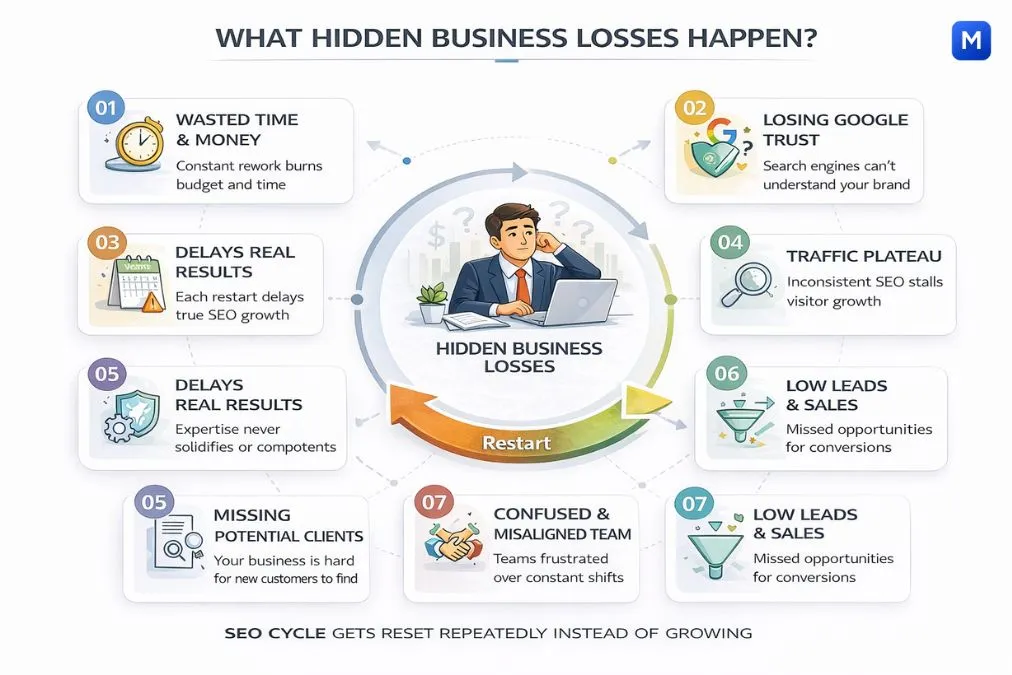
When you keep changing SEO agencies, the biggest losses are not always visible immediately. You lose time, money, and growth opportunities because your SEO never reaches the compounding phase. Instead of building momentum, your efforts keep restarting, delaying results, and weakening your long-term business growth.
From my experience, most businesses focus only on rankings and leads. However, they ignore the deeper losses happening in the background.
1. Money Loss Without Compounding
- Your budget gets used, but results never build over time
- Each new agency starts from zero instead of scaling previous work
- You keep paying for audits and setup again and again
As a result, you spend more but gain less.
2. Time Delay in Growth
- Your leads and revenue get delayed
- SEO never reaches the growth phase
- Months of effort get wasted without real outcomes
SEO works on compounding. When you interrupt it, you reset the timeline every time.
3. Competitor Advantage Increases
- Your competitors keep moving forward while you restart
- The gap between you and your competitors keeps growing
- Falling behind by months can push you years behind in rankings
While you restart, your competitors scale.
4. Brand and Data Damage
- Your brand voice and messaging keep changing
- Users and search engines get confused
- Your historical data becomes fragmented
- You lose clarity on what worked and what failed
As a result, you repeat the same mistakes and pay for them again.
I have seen businesses spend months across multiple agencies and still stay at the same level. The effort exists, but continuity is missing. Frequent switching does not just waste money. It slows your growth, weakens your brand, and gives your competitors a long-term advantage.
What Is Technical Debt in SEO and How Does It Affect Your Website?
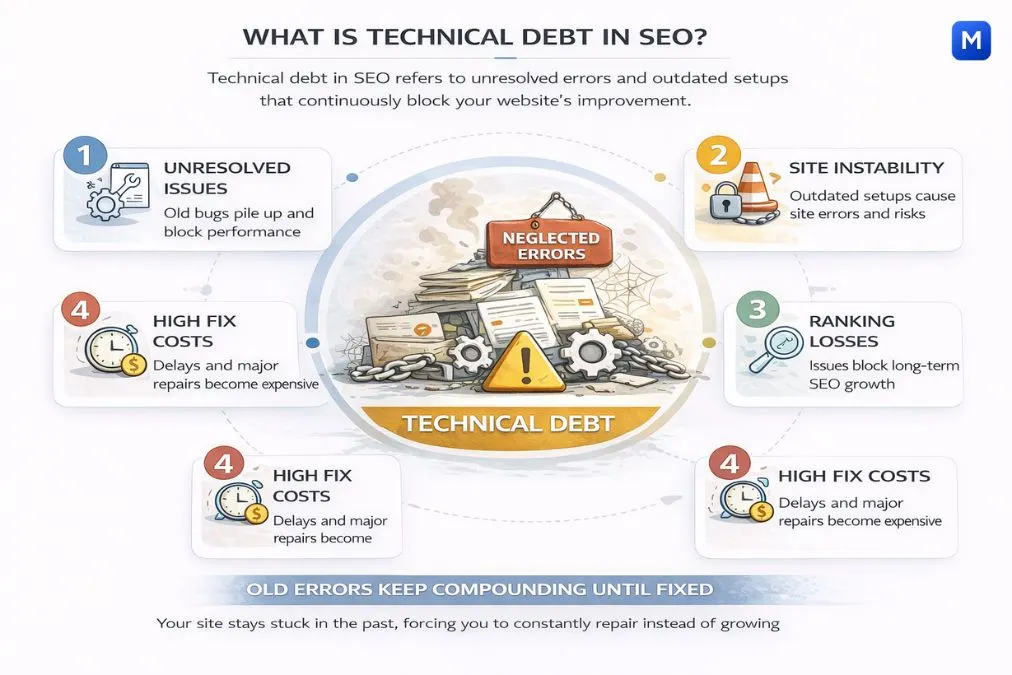
Technical debt in SEO builds when multiple agencies make changes without long-term consistency. Over time, your website accumulates broken setups, conflicting implementations, and hidden issues. Instead of supporting growth, these problems slow down performance, confuse search engines, and reduce your chances of ranking effectively.
From my experience, websites managed by multiple teams often suffer more from technical debt than from a lack of effort.
1. Plugin Conflicts and Broken Setup
- Different agencies leave behind tools and plugins
- Frequent changes create conflicts and slow down the site
- Code bloat increases, making the database heavy
As a result, Core Web Vitals drop, which directly impacts rankings.
2. Conflicting Schema Markup
- Multiple schema implementations send mixed signals
- Search engines struggle to understand your content clearly
This reduces your chances of appearing in rich results and AI-driven features.
3. Incomplete Internal Linking
- Some pages get optimized while others are ignored
- Content flow breaks across the website
This weakens your topical authority and reduces SEO effectiveness.
4. Crawl Errors and Redirect Issues
- Frequent URL changes create redirect loops and 404 errors
- Search engine crawlers get stuck or confused
As a result, important pages may not get indexed properly.
5. Growth Delays Due to Cleanup Work
- New SEO teams spend time fixing old issues
- Growth activities get delayed
Instead of scaling results, the focus shifts to repairing the foundation.
Technical debt builds silently, but it affects every part of your SEO. If your foundation is unstable, your growth will never sustain.
What Happens When You Lose Historical SEO Data?
When you keep changing SEO agencies, you lose more than strategy. You lose the history of what worked, what failed, and why certain decisions were made.
From my experience, this is a silent loss that most businesses ignore. Data may still exist in tools, but without context, it becomes difficult to use it for growth.
- No Proper Tracking or Annotations: Most agencies do not maintain detailed logs of changes. Without this, you cannot connect actions with results or understand what caused growth or drops.
- The Context Gap: Data Without “Why”: Tools show numbers, but they do not explain the reason behind them. A traffic drop may be visible, but the reason behind it remains unclear. In many cases, the previous agency handled an algorithm update or tested a strategy. However, the new agency does not know this, so they rely on guesswork instead of insight.
- Loss of Search Console Insights: Search Console data builds over time, but without context, it loses value. You see impressions and clicks, but you do not understand the story behind them.
- SEO Audit Fatigue (Wasted Time): Every new agency starts with fresh audits, keyword research, and competitor analysis. This work often repeats what was already done earlier. As a result, your budget goes into recreating old reports instead of generating new insights. At the same time, your first 2 to 3 months are spent on research instead of growth.
- Loss of Winning and Losing Data: SEO improves through testing, but switching agencies resets this learning. New teams repeat old experiments because they do not know what failed earlier. This means you keep paying to learn the same lessons again
Why Is the Wrong SEO Mindset Hurting Your Results?
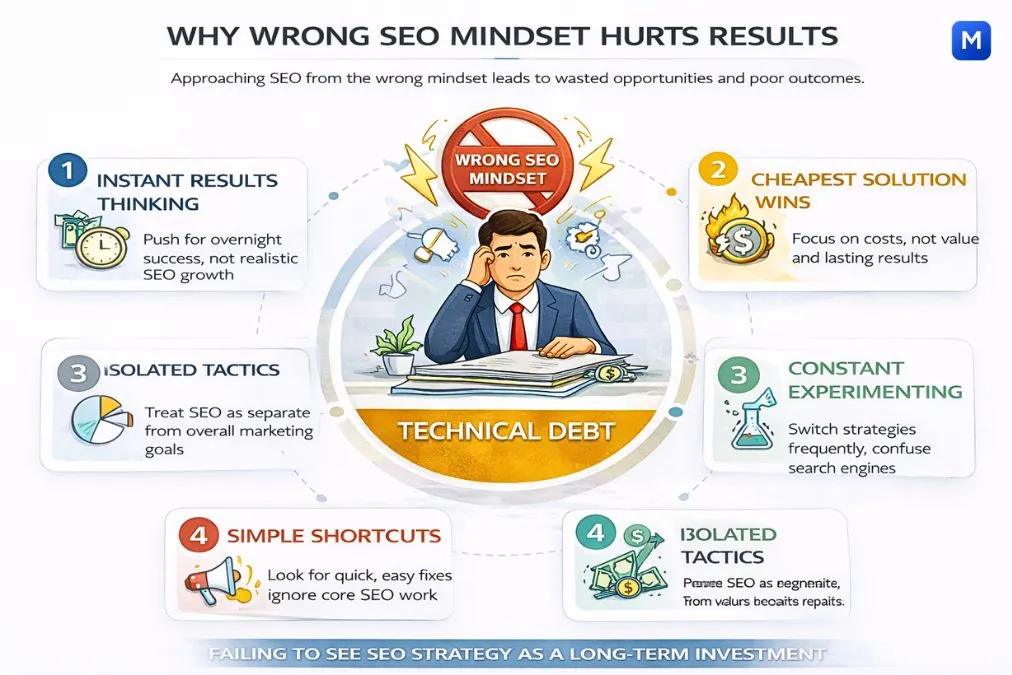
Most SEO failures stem from the wrong mindset, not the wrong agency. In my 12 years of experience working with different businesses, I have seen that early decisions and unrealistic expectations break SEO before it delivers results. Search engines reward consistency, expertise, and trust, not short-term actions.
From real project experience, these mindset mistakes repeatedly prevent SEO growth from reaching its full potential.
1. Treating SEO Like Paid Ads
- Many businesses compare SEO with paid ads
- Ads stop delivering the moment you stop spending
- SEO continues to grow when built correctly
In multiple client projects, I have seen businesses switch strategies too early because they expected ad-like results. However, SEO builds long-term value and authority, not instant traffic.
2. Expecting Instant ROI
- SEO does not deliver immediate returns
- Growth comes from consistent signals over time
- Authority and trust take time to build
Based on real campaign data, early months often show low visible results. However, this phase builds the foundation that drives long-term growth. Many businesses quit here without understanding this process.
3. Lack of Patience in Decision Making
- Decisions are made too early without data
- SEO is stopped before reaching the growth phase
- Search engines do not get enough time to build trust
I have audited multiple websites where SEO was stopped in Month 3 or 4. In most cases, the strategy was correct, but the timing of the decision was wrong.
When you align your mindset with how SEO actually works, results become predictable. SEO is not a short-term experiment. It is a long-term system built on experience, expertise, authority, and trust.
Why Do SEO Results Fluctuate and Should You Worry About It?
Organic strategy fluctuates because search engines constantly test, update, and re-evaluate websites. Traffic drops and ranking changes are normal during this process. However, many businesses panic and make early decisions, which breaks the recovery phase. Consistent SEO efforts usually stabilize and improve results over time.
From my experience handling multiple SEO campaigns, fluctuations are not failures. They are part of how search engines refine rankings and identify the best results.
1. Ranking Fluctuations Are Normal
- Rankings often move up and down, even in strong campaigns
- Google tests different pages before stabilizing positions
- Early volatility is part of the evaluation process
I have seen stable campaigns experience temporary drops before achieving stronger and more consistent rankings.
2. Google Updates Change the Landscape
- Algorithm updates can shift rankings across industries
- Visibility may drop suddenly without warning
- Search engines re-evaluate content quality and relevance
In most cases, websites with consistent SEO recover and perform better after updates.
3. Panic Leads to Wrong Decisions
- Businesses react emotionally to traffic drops
- SEO strategies get changed too early
- The recovery phase gets interrupted
From audit experience, many websites fail not because of bad SEO, but because of premature decisions.
4. Fake Promises Create False Expectations
- No one can guarantee rankings or fixed timelines
- SEO depends on multiple changing factors
- Unrealistic promises lead to poor decisions
Businesses that trust guaranteed results often lose patience and switch strategies too early.
SEO does not move in a straight line. It moves through testing, fluctuations, and recovery. If you stay consistent, results improve. If you panic, you restart the process again.
How Does SEO Work in 2026 with AI and Brand Authority?
SEO in 2026 focuses on AI visibility, brand authority, and consistent signals instead of just keyword rankings. Search engines now evaluate trust, expertise, and content consistency to decide which websites appear in AI-driven results. If your strategy keeps changing, your chances of building authority and visibility drop significantly.
From my experience working on modern SEO campaigns, the shift is clear. SEO is no longer about ranking pages. It is about positioning your brand as a trusted source. For local businesses, a focused local SEO strategy improves visibility and builds trust in specific areas.
1. SEO Is Now About AI Visibility
- Your content needs to appear in AI Overviews and featured results
- Search engines prioritize trusted and well-structured content
- Visibility depends on clarity, consistency, and authority signals
Websites that provide clear and valuable information get picked more often in AI-driven search results.
2. Brand Authority Matters More Than Ever
- Strong brands rank faster and more consistently
- Authority builds through experience, expertise, and trust
- Consistent messaging strengthens brand recognition
I have seen that websites with clear positioning outperform those chasing only keywords.
3. Content Consistency Builds Trust
- A clear content direction helps search engines understand your expertise
- Consistency improves topical authority and ranking stability
- Repeated signals build long-term trust
When your content aligns with a focused strategy, results become more predictable.
4. Frequent Changes Break Trust
- Changing agencies or strategies disrupts consistency
- Messaging and direction become unclear
- Search engines struggle to trust your brand
As a result, your visibility in both traditional and AI search drops.
SEO in 2026 is about becoming a trusted brand, not just ranking pages. Consistency, authority, and clarity are what drive long-term visibility and growth.
What Are AEO and GEO, and Why Do They Matter for SEO in 2026?
AEO (Answer Engine Optimization) and GEO (Generative Engine Optimization) are now essential parts of modern SEO. As search engines shift toward AI-driven results, your visibility depends on how well your content is structured for these platforms.
- AEO focuses on Direct Answers. Search engines pull direct answers from well-structured content. Your website needs clear, concise, and authoritative information. Without proper optimization, your content gets skipped in AI results.
- GEO Covers Generative AI Platforms. GEO optimizes your presence across Google AI Overviews, ChatGPT, and Perplexity. These platforms prioritize trusted and consistent sources. Your brand needs strong authority signals to appear in generative results.
- Both AEO and GEO depend on consistency and require long-term trust and stable content signals. Frequent agency changes break this consistency. As a result, your chances of appearing in AI-driven search drop significantly.
The SEO Playbook for Long-Term Growth
SEO works when you follow a clear process and stay consistent over time. Businesses that focus on structured execution instead of shortcuts see sustainable growth. Real results come from building trust, authority, and momentum step by step, not from quick fixes or temporary tactics.
From my 12 years of experience, SEO success always follows a defined process. A structured SEO approach, like professional SEO services, helps build long-term growth instead of quick wins.
1. Consistency Drives Results
- SEO rewards stable and continuous efforts
- Frequent changes break momentum and delay growth
- Consistent execution builds long-term signals
When your strategy stays stable, results start building gradually.
2. SEO Works on Compounding Growth
- Results do not appear instantly
- Small improvements multiply over time
- Growth accelerates after the foundation is built
SEO behaves like compounding. The longer you stay consistent, the stronger the results become.
3. Leads Come After Trust Builds
- Traffic alone does not generate business
- Trust and authority drive conversions
- Users engage more with credible websites
When your website builds trust, it starts converting visitors into leads consistently.
4. A Proven SEO Process Matters
A structured process ensures that every step contributes to long-term growth:
- Audit → Identify issues and opportunities
- Strategy → Define direction based on data
- Execution → Implement technical and content improvements
- Growth → Scale results through consistency and optimization
This process removes guesswork and creates predictable outcomes.
SEO is not about hacks or shortcuts. It is a system. When you follow the right process and stay consistent, it becomes a reliable growth channel instead of a risky experiment.
How Do Real SEO Decisions Impact Your Growth?
SEO success depends on the decisions you make early. Choosing the right strategy and staying consistent leads to growth, while frequent changes delay results. Businesses that focus on long-term execution see compounding returns, while those chasing quick fixes often stay stuck without measurable progress.
I have seen this pattern across multiple projects; the difference becomes clear when you compare real scenarios.
Real Example: Switching vs Staying Consistent
- A real estate business (Business A) changed 3 SEO agencies in 9 months
- Spent the budget on repeated audits and setup
- Saw no stable traffic or lead growth
- An e-commerce business (Business B) stayed consistent for 8 months
- Grew from 2,000 to 11,500 monthly sessions
- Focused on execution and improvements
- Achieved steady traffic growth and a 3x increase in qualified leads
| Parameter | Frequent Switching | Consistent Strategy |
|---|---|---|
| Budget usage | Repeated audits and setup | Builds on previous work |
| Google trust | Resets every time | Compounds over time |
| Traffic growth | Flat or declining | Gradual then exponential |
| Lead generation | Minimal | Starts after month 6 |
Common Client Mistakes
- Expecting fast results within 2–3 months
- Making decisions based on rankings only
- Ignoring early progress signals
- Switching strategies before they mature
These mistakes stop SEO before it reaches the growth phase.
When Should You Change Your SEO Agency?
You should consider switching only if:
- There is no clear strategy or roadmap
- Reporting lacks transparency
- Risky or spammy practices are used
- No communication or accountability exists
Otherwise, changing agencies too early causes more harm than good.
How to Choose the Right SEO Agency
- Look for a long-term approach, not quick promises
- Ask for a clear process and execution plan
- Prioritize experience and honest communication
- Avoid guaranteed rankings or fixed timelines
The right agency focuses on sustainable growth, not short-term wins.
SEO growth depends more on the decisions you make than the tools you use. When you choose consistency over shortcuts, results follow.
Final Takeaway: Stop Restarting, Start Building
SEO does not fail because it does not work. It fails because it is stopped too early. Most businesses quit before the strategy reaches the growth phase, and that is why they never see real results. If you keep changing agencies, you keep restarting your progress. But if you stay consistent, SEO starts compounding and delivering long-term growth.
The difference is not the agency. The difference is consistency. Also, every SEO project matters deeply to the professional handling it. A skilled SEO expert treats a website like a doctor treats a patient. They understand when to act, what to fix, and how much effort is needed at each stage.
Just like a doctor knows the right medicine and dosage at the right time, an SEO professional knows what your website needs at each phase. However, the difference comes down to experience. A senior expert brings deeper insight, better timing, and stronger decision-making.
That is why you should trust the expert you choose. Follow their guidance, stay patient, and allow them to work consistently on your website.
Stop restarting your SEO. Start building it the right way.
“Ready to build SEO that compounds? → Get a Free SEO Audit“
FAQs – Common SEO Questions Business Owners Ask Before Hiring an Agency
The 80/20 rule in SEO means focusing on the small set of actions that drive the majority of results. This usually includes targeting high-impact keywords, optimizing key pages, and fixing critical technical issues that influence rankings and traffic.
The four pillars of SEO are technical SEO, on-page SEO, content, and backlinks. These elements work together to improve visibility, build authority, and drive consistent organic growth.
SEO is evolving, not dying. It is shifting from keyword-focused strategies to brand authority, user experience, and AI-driven visibility in search results.
AI is not replacing SEO. Instead, it is changing how SEO works by introducing AI-driven search results, where content quality, clarity, and authority matter more than ever.
Frequent switching creates inconsistent signals, which confuses search engines. As a result, Google struggles to understand your brand clearly, weakening your authority and rankings.
In the first 90 days, you should expect audits, strategy planning, and implementation. This phase builds the foundation, while measurable results usually come after this stage.
Common red flags include guaranteed rankings, fixed timelines, lack of transparency, and unclear strategy. These often indicate unrealistic promises or poor SEO practices.
Many focus on shortcuts and quick wins instead of a long-term strategy. This leads to unstable results and prevents sustainable growth.
One of the biggest mistakes is stopping SEO too early or changing direction frequently. This prevents your strategy from reaching the growth phase.
ChatGPT can assist with analysis and recommendations, but a complete SEO audit requires real data, tools, and expert interpretation for accurate results.
If you are not seeing results from your current SEO efforts, the problem may not be SEO itself. It may be the strategy, execution, or timing.
Instead of switching blindly, get clarity first.
👉 Request a detailed SEO audit to understand:
- What is working
- What is holding you back
- What should be fixed next
This will help you make the right decision before investing more time and money.